

When the System Critiques Itself: What the Yale Trust Report Gets Right—and What Comes Next
Opacity may have once protected institutional flexibility. Today, it undermines institutional credibility.

Several subscribers have asked me to weigh in on the Yale report on trust in higher education. Many voices jumped in immediately. I wanted to take a different approach—be more deliberate, take the time to read it carefully, and avoid simply joining the chorus of quick reactions.
Let me start here: I consider myself data-driven. When data is gathered rigorously and analyzed by serious researchers, it deserves attention. Full stop. We may debate conclusions—but we shouldn’t dismiss the data.
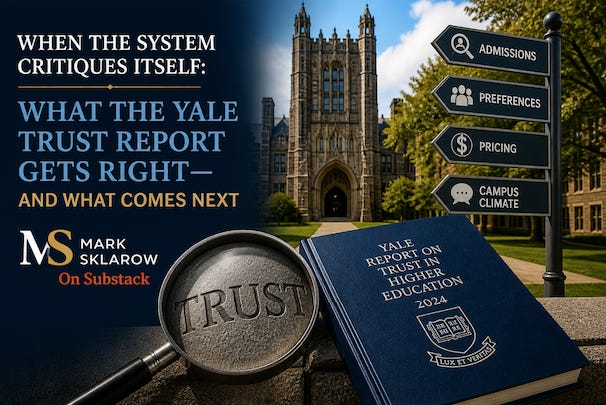
The recent Yale report has generated predictable headlines: declining public confidence, flawed and opaque admissions, confusing pricing, and campus climates under strain.
None of that is especially new.
What is new is where it’s coming from.
When an institution like Yale publicly questions the legitimacy of its own systems—especially admissions and campus climate—it signals something more than critique. It signals that the conversation has shifted from external (and often politically driven) pressure to internal concern.
For those of us who work closely with students and families, that matters.
First, a brief summary for those who haven’t had time to dig in—then my perspective and, yes, a few suggestions (because why shouldn’t I tell Yale and its peers what to do?).
Keep reading with a 7-day free trial
Subscribe to Mark Sklarow to keep reading this post and get 7 days of free access to the full post archives.